Showing posts with label Thriller Thursday. Show all posts
2

I'VE MOVED!!!!!!!!!!

Thursday, October 6, 2011


Hello all! After seeing how few responses the past few posts were getting and yet seeing the page view go up, I started investigating. Turns out a lot of people were having trouble leaving comments on Blogger, and I'm not the only one. So I finally bit the bullet and transferred the site to Wordpress. Still working out the kinks, but all the posts are there, including today's Thriller Thursday post.

Please come follow me at my new home!

http://stacygreenauthor.com/


Thanks!

--Stacy
6

Thriller Thursday: The Courtesy Due My Rank, a Civil War Murder

Wednesday, October 5, 2011


General Davis, Circa 1862.

Along with my love of suspense, true crime, and thrillers, Civil War history is another favorite, so today we're talking about a Civil War murder committed by Jefferson Davis.

No, not THE Jefferson Davis, the one and only President of the Confederate States of America, but Jefferson C. Davis, an officer in the United States Army. Davis served in the Mexican-American War, the Civil War, and the Modoc War. A proven soldier, Davis was inside the walls of Fort Sumter in 1861 when the rebels fired the first shots. A tenacious soldier, he was appointed Brigadier General of Volunteers in 1862. Despite his distinguished history, Davis is remembered for the similarity of his name to President Jefferson Davis and for murdering a superior officer during the Civil War.

In 1862, exhausted and emaciated, Davis left the Army on sick leave but returned to defend Cincinnati, Ohio. He soon found himself in Louisville, Kentucky reporting to Maj. General William Nelson.

Davis was a quiet man, but he was stubborn and known to have a temper. A biographer once described Davis as "aggressive, feisty, and confrontational with a fiery and combative spirit." Small and compact, Davis knew how to handle himself in a fight.

Jefferson C. Davis, standing second from right, with General Sherman and his staff.

In contrast, Maj. General William Nelson was over six foot tall and weighed around 300 pounds—no small feat in the lean days of the Civil War. Four years older than Davis, Nelson had gotten his start as a midshipman in the Navy and then quickly rose to rank during the Civil War. Known to be a bully, Nelson had been nicknamed "Bull" during his Navy days.

Major General William Nelson.

Not exactly a match made in heaven.

Davis was an Indiana boy, and Nelson a staunch Kentuckian. The two states didn't get along, and Nelson often referred to Hoosiers as "poor trash." A veteran soldier, Davis resented reporting to a man who'd only recently been given command of troops. Nelson ordered Davis to organize and train the "home guard," an assignment Davis would have been insulted by.


It didn't take long for the two men to clash. When Davis reported to Nelson at the Galt House, a fancy hotel serving as Army offices and Nelson's quarters, the Maj. General asked Davis for the number of troops gathered and how many weapons they needed. After only two days on the job, Davis later said he couldn't possibly have answered differently. Nelson was furious.


Maj. General James B. Fry

Maj. General James. B. Fry witnessed Nelson rise and glared down his nose at the diminutive Davis. The following is his description of his encounter:


"But you should know, I am disappointed in you, General Davis. I selected you for this duty because you are an officer in the regular Army, but I find I made a mistake.'


"Davis arose and remarked in a cool, deliberate manner:


"'General Nelson, I am a regular soldier, and I demand the treatment due to me as a general officer...I demand from you the courtesy due my rank.'


"Nelson replied: 'I will treat you as you deserve. You have disappointed me. You have been unfaithful to the trust I have reposed in you, and I shall relieve you at once. You will proceed to Cincinnati and report to General Wright.'


"Davis said: 'You have no authority to order me.'


"Nelson turned toward the Adj. General and said: 'Captain, if General Davis does not leave the city by nine o'clock tonight, give instructions to the Provost-Marshal to see that he shall be put across the Ohio!"


Needless to say, egos were severely wounded and all hell was about to break loose.


General Wright temporarily defused the situation, but when General Buell took over for Nelson, Wright sent Davis back to Ohio. Davis settled in and began planning an attack against rebels in Kentucky. On September 29, Davis entered Galt house to report. When Nelson arrived, Davis demanded an apology. Indiana Governor Oliver Morton and General Fry overheard the exchange.


Indiana Governor Oliver Morton

Fry said Nelson answered Davis's demand with a loud, "no!" and "said in a loud voice for all to hear, 'Go away, you damned puppy. I don't want anything to do with you!'"

Thoroughly insulted and embarrassed, Davis wadded up the paper he was holding and threw it in Nelson's face. Nelson slapped Davis with the back of his hand, made a nasty comment to Governor Morton, and stomped toward the staircase. Unbelievably, Davis took a pistol from a nearby friend, walked to within three feet of the towering Nelson and shot the unarmed general in the chest.


According to witnesses, Nelson dragged himself up the stairs before collapsing. "Send for a clergyman," he gasped. "I wish to be baptized. I have been basely murdered."


Davis was immediately arrested, but he insisted that while he wanted an apology, he had no intention of murdering Nelson. I'm not sure how you shoot a man point blank in the chest without intention, but I digress. Some officers screamed for Davis' immediate hanging. General Buell, an admirer of Nelson, called the act "a high crime and gross violation of military discipline. He intended to take quick action, but time was on Davis's side.


General Buell


Because time was short and quality officers in need, Buell didn't have the resources for a court marshall. He wanted Davis to be tried in Washington. Davis's friend Governor Morton lobbied on his behalf, and Davis was released with in a week. Some accounts also have General Wright coming to Davis's aid and gaining his release from prison. He escaped conviction because the Union Army was in desperate need for experienced field commanders, and within fourteen days of murdering Nelson, Davis received division command in the Army of the Cumberland.


General Davis, circa 1865.


Davis did receive a very tiny punishment for the murder: he never reached a rank higher than brigadier general of volunteers. He did earn a temporary promotion to major general of volunteers on August 8, 1864, then was appointed commanding officer of the XIV Corps, a post he retained until the end of the Civil War.


Controversy continued to surround Davis during the Ebenezer Creek passing. His racist attitude toward freed slaves was deplorable. On December 9, 1864, Davis ordered a bridge removed before the refugee slaves following his army could cross. Hundreds of slaves were either captured by Confederates or drowned in the Creek.


Davis with his staff in Washington D.C. in 1865


Davis stayed in the Army after the war. He was the first commander of the Department of Alaska. True to his crusty nature, he forced the Russian settlers of Sitka, Alaska out of their homes because they were "needed for Americans." In the Modoc War, Davis's field prowess was an asset, resulting in the successful Battle of Dry Lake.

Crown Hill Gateway, Crown Hill Cemetery, Indianapolis, Indiana.

Jefferson C. Davis died in 1879 at age 51 in Chicago. He was buried in Crown Hill Cemetery in Indianapolis, Indiana. Crown Hill is the place for Indiana's soldiers and celebrities, and it's a beautiful cemetery. On a personal note, my great-great grandfather Peter Fisher is buried at Crown Hill. He served in the Civil War, and we're lucky enough to have his Colt Revolver.


Jefferson C. Davis Grave Site, Crown Hill. Image credit Seth Musselmen.


Clearly this was a case of egos and tempers out of control. In the days when gentlemanly conduct was highly valued, it's astounding Davis wasn't tried. Do you think General Davis should have served time for the murder, or did the needs of the Union Army outweigh justice?

20

Manic Monday: Liebster Awards, Row80, and YOU!

Sunday, October 2, 2011


Happy Monday, everyone! I hope you had a fantastic weekend. Our weather here was beautiful, and I got some serious plotting/writing done on The Prophet, so I'm happy.

Today's post is a Mish-Mash (to steal Kelly Hashway's phrase). First, I have to give a huge thank you to the wonderful Jenny Hansen for bestowing me with the Liebster Award.


Liebster is German for "beloved person." Jenny said some very sweet things about me, and I'd like to return the favor. Jenny and her blog, More Cowbell, are always fun and positive. She's a fantastic cheerleader and a great teacher as well.

I'd like to give the Liebster to these blogging friends:

Jessica Patch: Her blog is fun and uplifting, and she's always willing to help out a fellow writer. She recently signed with Rachel Kent of Books and Such Literary, so huge congrats!

J. Thomas Ross: J is lucky enough to have access to some great conferences and writing groups, and she's always willing to share what she's learned.

Donna Galanti: First off, HUGE CONGRATS to Donna for signing with Echelon Press. I'm so happy for her! I want to give her the Liebster because Donna was one of my first "writing" friends. She embraced me when I was just starting out and gave me a lot of great guidance. Her blog is always informative, and she has fun author interviews.

Amber West: Amber not only posts great posts about which TV shows are worth your time, but she also has wonderful Friday Inspiration posts. She recently launched the #Gowithout campaign for charity, and I'm proud to take part.

Finally, I want to mention two great bloggers that already have Liebsters. Catie Rhodes is my critique partner and friend. Her blog is one of my favorites, covering everything from cool 80s movies, Texas history, true crime, and freaky paranormal stories. Tiffany White is another blogging friend, and her blog (along with Amber West's) is the go-to place for finding great, new television shows. Thanks to these ladies for all their support!


Last but not least, it's almost time for the "Rock the ROW" Twitter party! On October 5th, the #Row hashtag will be THE place to be. Jenny Hansen has all the details here. "Rock the Row" is our opportunity to celebrate our accomplishments from #Row80 Round 3, and it's also the kick off for Round 4. If you haven't taken part in Row80, I definitely encourage you to. It's a great way to stay motivated to reach your writing AND life goals.

If you don't know what #Row80 is, take a minute and check out Kait Nolan's post. She's the brain behind #Row80.

Round 4 begins today, October 3rd, and runs through December 22. That's 80 days to get some serious work in. I went easy on myself in Round 3, so I'm upping the stakes this time.

Yes, it's Calvin and Hobbs day at Turning The Page. :)

My Round 4 #Row80 Goals:

Writing:
Begin querying Light and Dark by November 15. Some of this hinges on my final critique partner getting the time to read the MS, but I'm determined to have sent FIVE queries out by the end of Round 4.

Write a minimum 3000 words/week on my new suspense thriller, The Prophet. If I can manage that pace, the first draft will be about halfway complete by Christmas.

Continue to blog three times a week and work on spreading the word about Thriller Thursday. Those posts really tie into my genre, and I want to add focus to them.

Continue to support my blogging/writing friends on their individual journey's.

Life:
Stick to my healthy eating schedule. Do a better job of watching my carbs.

Continue with yoga. Build workouts to at least four times a week.

Spend more time reading with my daughter.

Focus on the positive things in my life: friends, family, my chance to write.

Focus on the stuff I CAN change about myself instead of worrying about what I can't.

What about you? Will you be joining #Row80?

18

Thriller Thursday: The Vampire of Sacramento

Wednesday, September 28, 2011


Every rational person knows vampires aren't real. There are no undead cursed to walk the earth for eternity searching for their next victim. And delicious-smelling, sparkly vampires who don't feast on humans are certainly the stuff of an overactive imagination.

But individuals with blood cravings do live among us. We just have a scientific term for them: cannibals. Of course there have been cultures that have accepted cannibalism, but we're not talking about those. Eating people is pretty taboo here in the States, but that didn't stop Richard Trenton Chase.

Nicknamed "The Vampire of Sacramento," Richard Chase went on a month-long killing spree in December, 1977 that resulted in six deaths. Chase earned the creepy nicknamed because he drank his victim's blood and cannibalized their remains.

Richard Trenton Chase mugshot, 1978

Like many of history's horrific murderers, Chase claimed he was abused by his mother. His parents fought a lot and were divorced by the time he was twelve. By then, Chase exhibited the core ingredients of the MacDonald Triad (the behavioral characteristics associated with sociopaths) and was an alcoholic and drug abuser by the time he was in his teens.

Chase was a hypochondriac, worrying about his heart ceasing to beat or that someone had "stolen an artery." He held oranges to his head so the Vitamin C would be absorbed via the brain, and he also believed his cranial bones had separated and moved around. He shaved his head in order to watch.

Throughout his life, Chase was terrified he would simply disappear. He believed the Nazi's, FBI, and space aliens were after him. The soap dish was his tormenters weapon of choice. Chase believed it held a secret poison that slowly turned his blood to powder. He knew only fresh blood could save him.

Chase's roommates complained about his drug use and his love of walking around the apartment nude. He refused to move out, so they left and Chase was on his own.

Like many sociopathic serial killers, Chase tortured animals, but he took it a step farther. He disemboweled the animals and ate them raw, often mixing the organs with Coke and making a gruesome milkshake. He believed eating the animals kept his heart from shrinking.

Blenders used by Chase.

In 1975, Chase injected rabbit blood and wound up in the hospital. The mental institution soon followed. He was discovered drinking blood of birds - their corpses were throw out of the window. Witty hospital staff dubbed him Dracula.

Chase had a strong addiction to blood. At the insituation, he stole blood from the therapy dog after stealing syringes from boxes left in the doctor's offices. He was also known to defecate himself and then paint with the feces.

Totally disgusted yet?

For some amazing reason, doctors decided Chase's was no longer a danger to society after a round of psychotropic drugs, and he was released in 1976 under the care of his mother. Evidently his mother thought she knew more than the doctors—she took him off the antipsychotic meds because the drugs made him "a zombie." She also got Chase his own apartment. Smart. In the months that followed, Chase refused to allow his mother to enter his apartment. She did nothing but continue to pay his rent.

Neighborhood pets, including his mother's cat, fell victim to Chase's bloodlust. Still, his animal blood-and-guts cocktails weren't enough to sustain him.

Chase's first human sacrifice was discovered on Jan. 23, 1978. David Wallin returned to his North Sacramento home to discover his pregnant wife, Terry, murdered. Her torso was slit open; parts of her body had been eaten. Chase had used a yogurt container to drink Terry's blood. The only picture of Terry I could find was extremely graphic.

The FBI behavioral science unit was in its infancy, and police worked closely with the group to come up with a profile to catch the unknown killer. Robert Ressler and Russ Vorpagel sketched an eerily close likeness of Chase, dubbing the suspect a scrawny, young loner, unkempt, dirty, and unorganized, subsisting on someone else's money.

Police sketch of Chase (I couldn't verify if this was the one Ressler created).

Chase 1971 Mug shot.

Accurate as the profile was, it didn't prevent further murders by Chase. Four days later, Evelyn Miroth, her friend Daniel Meredith, and Evelyn's son, Jason, were found shot with a .22 and slashed open. David was only six. Miroth's twenty-two-month old nephew David Ferreira had disappeared after being left in Evelyn's care that day. His crib contained a telltale bloodstain, and the baby's decapitated corpse was discovered four months later.

Evelyn Miroth

Jason Miroth

Evelyn lie naked on the bed, her legs open. Her abdomen had been slashed and her intestines pulled out. Two red-stained carving knives were nearby. Evelyne had been sodomized with the knife at least six times. Her neck had been severely slashed, and bloody ringlets on the carpet indicated the killer had again used something to collect blood. Several internal organs had been stabbed as well. The coroner later said this would help blood pool in the abdomen.

Ressler and Vorpagel believed the killer would be disorganized, with clues pointing to psychosis. The crimes weren't planned, and the killer likely did very little to hide the evidence. He left footprints and fingerprints at the scenes and had probably been seen walking in daylight with bloody clothes. Because he'd walked to at least one crime scene, the FBI believed he lived in the vicinity of the crimes. They were also sure he would keep killing until caught.

Crime scene photo.

A chance encounter turned out to be Chase's downfall. A young woman named Nancy Holen was shopping when a strange man approached her. He appeared confused, and Nancy tried to avoid him.

"Were you on the motorcycle when Kurt was killed?" the man asked.

Nancy was shocked. Ten years earlier, her boyfriend Kurt had been been killed on a motorcycle. Suddenly she noticed something familiar about the strange man. When he told her he was Rick Chase, she was shocked. She remembered Rick as a clean-cut, studious high school kid. The man before her was dirty, his clothes were stained, and he was agitated. She managed to get out of the store while Chase was distracted, but he followed her into the parking lot and asked for a ride. Nancy jumped into her car, rolled up the windows, locked the doors, and booked it out of the parking lot before he could stop her. When she saw the police sketch, she was positive Chase was the man police sought.


When Chase showed up on the police's radar, everything added up: the history of mental illness, the physical decline, his reliance on his mother. When Chase was apprehended, he wore an orange parka with blood stains on it. A .22 semiautomatic with bloodstains was taken from him, as well as Dan Meredith's wallet. Chase had been carrying a box when police grabbed him, and it contained bloodstained paper and rags. At the station, Chase admitted to killing dogs but refused to discuss the murders.

The search of Chase's apartment was horrifying. Nearly all of his possessions were stained with blood—including food and glasses. Small pieces of bone were found in the kitchen; the refrigerator held dishes with body parts. One container had human brain tissue. A blender was stained and reeked. Three pet collars were found but there were no animals to match. Pictures of human organs lay on a table along with newspaper ads selling dogs. The ads were circled.

A calendar had the inscription "today" on the dates of the Wallin and Miroth murders, and the same word was written on forty-four future dates.

Chase on his way to court.

Chase was eventually linked to another murder, the Dec. 29, 1977 drive-by of Ambrose Griffin. Chase confessed Griffin's was his first human victim. He said he chose his victims simply because their doors had been unlocked.

Prosecutors wanted the death penalty, and the defense argued not guilty by reason of insanity. This is one time that defense might have an ounce of merit. I don't know how much Chase plotted in advance, but there's no doubt he neither understood or cared about the consequences of his actions. The jury agreed with the prosecution and found Chase guilty of six counts of murder. He was given the death sentence.

Chase hid the anti-depressants offered to calm him, and on December 26, 1980, he committed suicide like a true coward.

In all my research of serial killers, Richard Trenton Chase is one of the very worst. I do believe he was in a different frame of mind than someone like Dahmer, who was much calculating and controlling. Had Chase been on meds and under careful care, his victims might have stood a chance.

What do you think? Was Chase destined to be a killer? Would meds have helped? Is there really such a thing as not guilty by reason of insanity?


25

Thriller Thursday: America's Most Haunted Prison

Wednesday, September 21, 2011

Eastern State Penitentiary circa 1920.

In the late eighteenth century, a group of powerful and determined Philadelphians met in Benjamin Franklin's home. Calling themselves "The Philadelphia Society for Alleviating the Miseries of Public Prisons," the group set out to improve the miserable conditions of prisons in the United States and Europe. Dr. Benjamin Rush had the idea to build a true penitentiary, a building designed to create regret and penitence.

Eastern State's front gate.

Eastern State Penitentiary opened in 1829. Guided by the Quaker-inspired idea of isolation from other prisoners, the system was strict. Prisoners had a toilet, table, bunk, and Bible in their cells where they were locked in all but one hour a day. When they did leave, a black hood was shoved over their head to prevent distraction and interaction as well as knowledge of the massive building.

Many notorious criminals spent time behind Eastern State's walls, including Al Capone and bank robber Willie Sutton. Capone's time at ESP came shortly after the St. Valentine's Day Massacre, and he claimed the ghost of victim Jimmy Clark visited him on his cell.

Naturally, Capone's cell differed from the other prisoner's.
"The whole room was suffused in the glow of a desk lamp which stood on a polished desk. On the once-grim walls of the penal chamber hung tasteful paintings, and the strains of a waltz were being emitted by a powerful cabinet radio receive of handsome design and fine finish." -- Philadelphia Public Ledger, August 20, 1929.
Capone's restored cell at ESP today.

Despite the supposed goal of better treatment and prison conditions, harsh punishments were often doled out at ESP.

The Water Bath: An inmate was dunked in ice-cold water and then hung from a wall for the night. This punishment was most popular during the winter months, and the water would freeze into a layer of ice on the inmate's skin before morning.

The Mad Chair: Given its name because a prisoner was likely to go mad before the punishment ended. Inmates were strapped to the chair so tightly with leather strips they couldn't make even the smallest movements. They were left for days, without food, until the circulation in their body nearly stopped.

Some argue this is simply a barber's chair; others insist it's Eastern's Mad Chair.

Iron Gag: Designed for inmates who refused to obey the no communications policy. An iron collar was clamped onto the tongue of the inmate and then chained to his wrists, which were strapped high behind the back. Movement caused the tongue to tear and severe bleeding. Many died from loss of blood.

Drawing of Eastern's Iron Gag

The Hole: Resting beneath Cell Block 14, the hole was a dark pit where inmates would remain for weeks with no light and very little air. Inmates tossed in received water and a slice of bread, which they'd have to fight the roaches for.

Eastern State closed its doors in 1971 after people began to question the effectiveness of solitary confinement, but many believe some sort of life still exists behind its now crumbling walls. As early as the 1940s, prisoners and guards alike reported visions and creepy experiences throughout the building. Between the violent criminals Eastern housed and the harsh punishments doled out, it's no wonder the place is alive with paranormal energy.

One of the most commonly seen ghosts is an inmate who killed twenty-seven men during an attempted escape. Besides the random specters, strange sounds are heard on a regular basis.

Cell Block 4

A major paranormal episode happened to a locksmith doing restoration work in Cell Block 4. He was struggling to remove a 140-year-old lock from the cell door when a powerful force overcame him, rooting the locksmith to the spot. According to the man, he was drawn to the negative energy that burst through the cell. Anguished faces appeared on the wall and distorted forms rushed through the cell block.

Now a major tourist attraction, paranormal experiences at ESP are frequent occurrences. Voices, weeping, and tormented screams are heard while numerous shadows are seen darting in and out cells.

"When my mother, my sister, and I visited in 2004, we caught not one, but two EVPS (electronic voice phenomenon—a disembodied voice that isn't audible to the naked ear, but can be heard via digital recording) in the exact same spot. We were up by ourselves on the stairs that lead to the catwalk, snapping a few photos when a voice came through sternly instructing us, "you don't have to take a damn picture." Just moments later, the same voice manifested again, this time forlornly stating, "I'm lonely..." - Blue Moon Ghost Hunters

Cell Block 12, reported to have the most paranormal activity.

Active areas include Cellblock 12, where voices and raucous laughter can be heard, Cellblock 6, where shadowy figures are seen against the walls, and Cellblock 4. Footsteps have been heard in the corridors, and wailing is often emitted from the secluded cells.

Cell Block 6

Eastern State is a favorite spot for paranormal investigators. Ghost Hunters garnered some pretty creepy evidence a few years ago. If you want to see the guys exploring the prison, watch the whole video, but the good stuff starts at about 5:45.


Eastern State takes full advantage of its frightening reputation by hosting Terror Behind The Walls - the ultimate Halloween haunted house.

Eastern State is definitely on my list of possible haunted places to visit. What do you think? Is the evidence compelling? Would you be brave enough to embark on Terror Behind the Walls? Have you had any awesome paranormal experiences?

Thanks to Catie Rhodes for the idea of featuring Eastern State!

Other ESP Links:


34

Thriller Thursday: The Sweet Face of Pure Evil

Tuesday, September 13, 2011

Mary Bell in 1968, aged 10.

Look at that face. So sweet, almost cherubic. An innocent child, right? Wrong. Mary Bell murdered two toddlers when she was just ten years old, making her one of the youngest (if not the youngest) serial killers in history and a true psychopath.

Mary Bell lived about 275 miles north of London in the small town of Scotswood. Her mother was a prostitute and her father unnamed, although he was thought to be Billy Bell, a known criminal. Family members would later claim Mary attempted to murder her mother several times as a child. Mary would also say she was a victim of sexual abuse and that her mother forced to her to have sex with men as a young child.

On May 25, 1968, just a day before her eleventh birthday, Mary strangled four-year-old Martin Brown and left his body in a condemned house. He small hands couldn't squeeze hard enough to leave marks, and the murder went unsolved.

Martin Brown

Then, in July, Mary decided she wanted to kill again. She chose three-year old Brian Howe as her victim and enlisted the help of her troubled friend, Norma. The little boy was found in an industrial area, covered with grass and weeds. A pair of scissors lay nearby. There were puncture marks on his thighs, his genitals partially skinned. Clumps of hair were missing. An "M" had been etched onto the boy's tummy with a razor blade.

There was a terrible playfulness about it, a terrible gentleness if you like, and somehow the playfulness made it more, rather than less, terrifying. - Inspector James Dobson.

Brian Howe

Before Brian's body was discovered by police, Mary and Norma had offered to help the toddler's older sister Pat search for him, going so far as to take her into the industrial area where his body lay. Mary wanted the sister to find the boy's body, "because she wanted Pat Howe to have a shock," Norma later said. Pat insisted he wouldn't go that far from home and left.

Although she was barely eleven, Mary Bell immediately stood out to investigators, along with her friend Norma. Mary acted aloof while Norma was animated and excited, one authority said, "smiling as if it were a huge joke."

With investigators honing in on her, Mary's memory conveniently returned. She told investigator she saw a boy with Brian on the day he died. She claimed he hit the toddler for no reason, and that she had also seen the same boy playing with broken scissors. Even a calculating psychopath makes mistakes: the boy in question had been at the airport the day Brian died, and the scissors had been kept confidential. Mary described the scissors in detail, right down to their silver coloring and broken leg.

The scissors Mary Bell used to mutilate Brian Howe.

On August 7th, Brian Howe was laid to rest.

"Mary Bell was standing in front of the Howe's house when the coffin was brought out. I was, of course, watching her. And it was when I saw her there that I knew I dare not risk another day. She stood there, laughing. Laughing and rubbing her hands. I thought, My God, I've got to bring her in, she'll do another one." - Inspector Dobson.

Dobson questioned Norma before Brian's funeral. The girl now said Mary told her she had killed Brian and showed her his body. Mary allegedly told Norma "I squeezed his neck and pushed up his lungs, that's how you kill them." Norma claimed that when Mary showed her the body, Mary stroked the dead boy's lips and said she had enjoyed killing him.

Police picked Mary up, and Dobson said that while the child was weary, she kept her wits. Dobson tried a variety of tactics with Mary, hoping to entice the truth out of her.

"I have reason to believe that when you were near the blocks with Norma, a man shouted at some children and you both ran away from where Brian was laying in the grass. This man will probably know you," Dobson said.

"He would have to have good eyesight."

"Why would he need good eyesight?" Dobson asked.

"Because he was...clever to see me when I wasn't there." Mary then said she was being brainwashed and that she was going home. Dobson refused and forged on. Mary held fast.

"I am making no statements. I have made lots of statements. It's always me you come for. Norma's a liar, she always tries to get me into trouble."

Note written by Mary Bell after the murders, found at a nursery she and Norma broke into.

Ignoring the nagging voice in the back of his head, Dobson allowed Mary to leave. He later brought her back to the station after getting more information from Norma.

Still cool under pressure, Mary finally admitted to being present when Brian died but implicated Norma as the actual murderer. Mary claimed she tried to pull Norma off the little boy, but that Norma screamed at her and kept strangling him. You can read Mary's full statement here.

When Dobson told Mary she was being charged with the murder of Brian Howe, she reportedly said, "That's all right with me."

Once she was incarcerated, stories of Mary's bizzarre behavior and abuse began to surface. Other children said she was a show off, and they didn't believe her when she went around claiming she was a murderer.

According to friends and family, Mary had pushed her cousin several feet off a ledge behind some sheds, leaving him bleeding from the head. She also attacked three girls at a daycare, with Norma in tow. One of the girls claimed Mary had squeezed her throat, asking "what happens if you choke someone, do they die?"

Headline during Mary Bell's trial.

Mary was soon connected to Martin Brown's murder that had occurred months earlier. The three boys who had found the boys body remembered Mary and Norma squeezing through a broken section of boards to get into the house. Mary had brought Norma to show her the boy's body.

Because police could find no signs of violence, the cause of death had been left open. But ice-cold Mary and Norma revelled in tormenting the boy's aunt, asking her if she missed Martin and if she cried for him.

The girls didn't stop there. June Richardson, Martin's grieving mother, was also a target.

"Mary smiled and asked to see Martin. I said, 'no pet, Martin is dead.' She turned round and said, 'Oh I know he's dead. I wanted to see him in his coffin.' She was still grinning. I was just speechless that such a young child should want to see a dead baby, and I just slammed the door on her."
June Richardson with a picture of Martin.

At trial, the psychiatrist who had interviewed Mary said she exhibited the classic signs of psychopathy: she showed no remorse and was completely unemotional. Mary Bell was convicted of manslaughter while Norma was found not guilty and placed under psychiatric evaluation.

I have no idea how she only received manslaughter, but I can only assume it was because of her age.

The authorities had no idea what to do with an eleven-year-old murderer, so Mary spent the rest of her juvenile years floating from one institution to another. After the conviction, she continued to make headlines as her heartless and greedy mother sold stories about her to the press. In 1977, Mary escaped from Moore Open Court Prison, where she'd been since her transfer from a young offenders institution.

Mary Bell at 16.

Mary was released from prison in 1980 at the age of twenty-three, serving only twelve years for the murders of two helpless little boys. Even worse, she was granted anonymity, including a new name, to start a new life with her daughter (born in May, 1984). Their location was eventually discovered and the two had to escape the house under the cover of bed sheets. Yet another innocent child had been affected by Mary's hideous actions, but this time it was her own flesh and blood.

Mary Bell in 1980 after her release.

Mary and her daughter were supposed to lose their anonymity when the child turned 18. But to the heartbreak of the victim's families, Mary Bell succeeded in having her own anonymity and her daughter's extended for life.

The Brown and Howe families were devastated. Mary had not only served very little time for the double homicides, but she also made money with an autobiography and would now be able to hide behind her daughter for the rest of her life, effectively negating any accountability.

Bell recently had a grandchild, and the order has been extended to include him.

"A child is a blessing. She took my blessing and left me with grief for the rest of my life. I hope when she looks at this child she remembers the two she murdered. I will never see a grandchild from my son. I hope when she looks at this baby she realized what my family are missing out on because of what she has done."
-- June Richardson, mother of Martin Brown.

You can find much more of Mary's story here.

In all my research of violent crimes, this has to be the worst. The chilling way Mary spoke of her victims and her utter lack of remorse is astounding. What do you think? Should she have served more time, and should she be allowed anonymity?
20

Thriller Thursday: Kitty Genovese and the Bystander Effect

Thursday, September 8, 2011


On a dark spring morning in 1964, Catherine Susan Genovese arrived home from her job as a bar manager at Ev's Eleventh Hour Sports Bar in Queens. She parked about one hundred feet from her apartment door, located in an alley way at the back of the building. As she walked, she was approached by an unfamiliar African-American male. Genovese ran across the parking lot toward the front of her building, but the man quickly overtook her, stabbing Genovese twice in the back.

Stunned and in pain, Genovese's scream cut through the quiet night. "Oh my God, he stabbed me! Help me!" Several neighbors heard the cry but with the windows closed, only a few recognized it as a cry for help. A neighbor shouted at the attacker to leave the girl alone, and the man took off.

The apartment on Austin Street, Queens.

Irene Front heard Catherine's screams. "There was another shriek," she testified in court. "And she was lying down crying out."

The night was once again quiet, the only sound Catherine's sobbing as she struggled to her feet. Blood streaming from her wounds, Catherine staggered to the side of her building and fought for consciousness. Within five minutes, her attacker had returned and stabbed her again.

"I'm dying, I'm dying," Catherine cried out. Lights again flashed on, windows opened as tenants peered into the night. The attacker was spotted racing to a white Chevy Corvair and driving away.

From the sixth floor of the apartment building, Marjorie and Samual Kroshkin witnessed the attack from their window.

"I saw a man hurry to a car under my window," he said later. "He left and came back five minutes later and was looking around the area. "Mr. Koshkin wanted to call the police, but Mrs. Koshkin thought otherwise. "I didn't let him," she later said to the press. "I told him there must have been thirty calls already."

Another witness later said at trial that she heard a scream for help three different times. "I saw a girl lying down on the pavement with a man bending down over her, beating her."

Determined to live, Catherine made her way to the rear of her building and tried to enter through a back door. It was locked. She slid along the wall until she reached a hallway leading to the second floor, but lost her footing and fell. The man returned.

.
The alley where Catherine was stabbed.

"I came back because I knew I'd not finished what I set out to do," the man later told cops. He searched for Catherine until he found her slumped in her own blood and semiconscious. He cut off her bra and panties and sexually assaulted her, then took $49 from her wallet.

"Why would I throw money away?" He asked the court at trial.

He finished the job, stabbing Catherine to death, and then left the scene. The entire event lasted 32 minutes.

Karl Ross, a neighbor on the second floor, finally called the police at about 3:50 a.m., but only after calling a friend and asking his opinion about what he should do. A squad car arrived within minutes and discovered Catherine's body. She'd been stabbed 17 times. A neighborhood canvas churned up 38 people who had heard or seensome part of the assault on Catherine.

38 people. 32 minutes. Anyone could have saved her.

A myriad of excuses followed: one tenant thought it was a lover's quarrel, others were afraid, some women didn't want their husbands involved. Some claimed they couldn't see what was happening. One witness said he was too tired.

The murder of Catherine "Kitty" Genovese was just one of many in NYC in 1964. It wasn't until the New York Times published "38 Who Saw Murder Didn't Call The Police" by Martin Gansberg that the killing became real news. Press flocked to the KewGardens in Queens, the residential neighborhood where the murder had taken place. The witnesses were chewed up in the press, but many now claim the article was misleading. No neighbor witnessed the entire attack, as it was spread out over three different areas. But the fact remains that an early call to the police could have changed everything.

Kitty's murder jumpstarted a new line of psychological research into the phenomenon known as the Bystander Effect. Experts found the probability of help is related to the number of bystanders; the more people watching, the less likely they are to intervene. In a world full of apathy and self-preservation, most people assume someone else will make the call or step in to help.

Television was also blamed for the inaction.

"We underestimate the damage that these accumulated images do to the brain. The immediate effect can be delusional, equivalent to a sort of post-hypnotic suggestion. The witnesses became confused and paralyzed by the violence they witnessed outside their window. They were fascinated by the drama, by the action, and yet not entirely sure that what was taking place was actually happening."
--Psychiatrist Ralph S. Banay

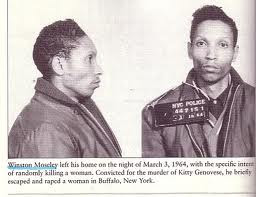
Winston Mosely

The attacker was identified as Winston Moseley. He was later arrested in connection with burglary charges and confessed to the murder of Kitty Genovese and two others. His confession details the attack, and he stated his motivation was to kill a woman. He chose Kitty at random.

Moseley showed no remorse and was given the death sentence. But in 1967, the New York Court of Appeals found that Moseley should have been able to argue he was medically insane at the sentencing hearing, and the sentence was reduce to life.

During a 1968 trip to the hospital for surgery, Moseley attacked a guard and beat him, then took a bat and started swinging at those around him. He took five hostages, raping one in front of her husband. He was recaptured after a two-day manhunt. Moseley has been denied bail thirteen times. His next hearing is in November.

Kitty's murder is a sad representation of some of our worst traits: apathy and selfishness. What would you have done? Do you know of any other murders affected by the Bystander Effect.